
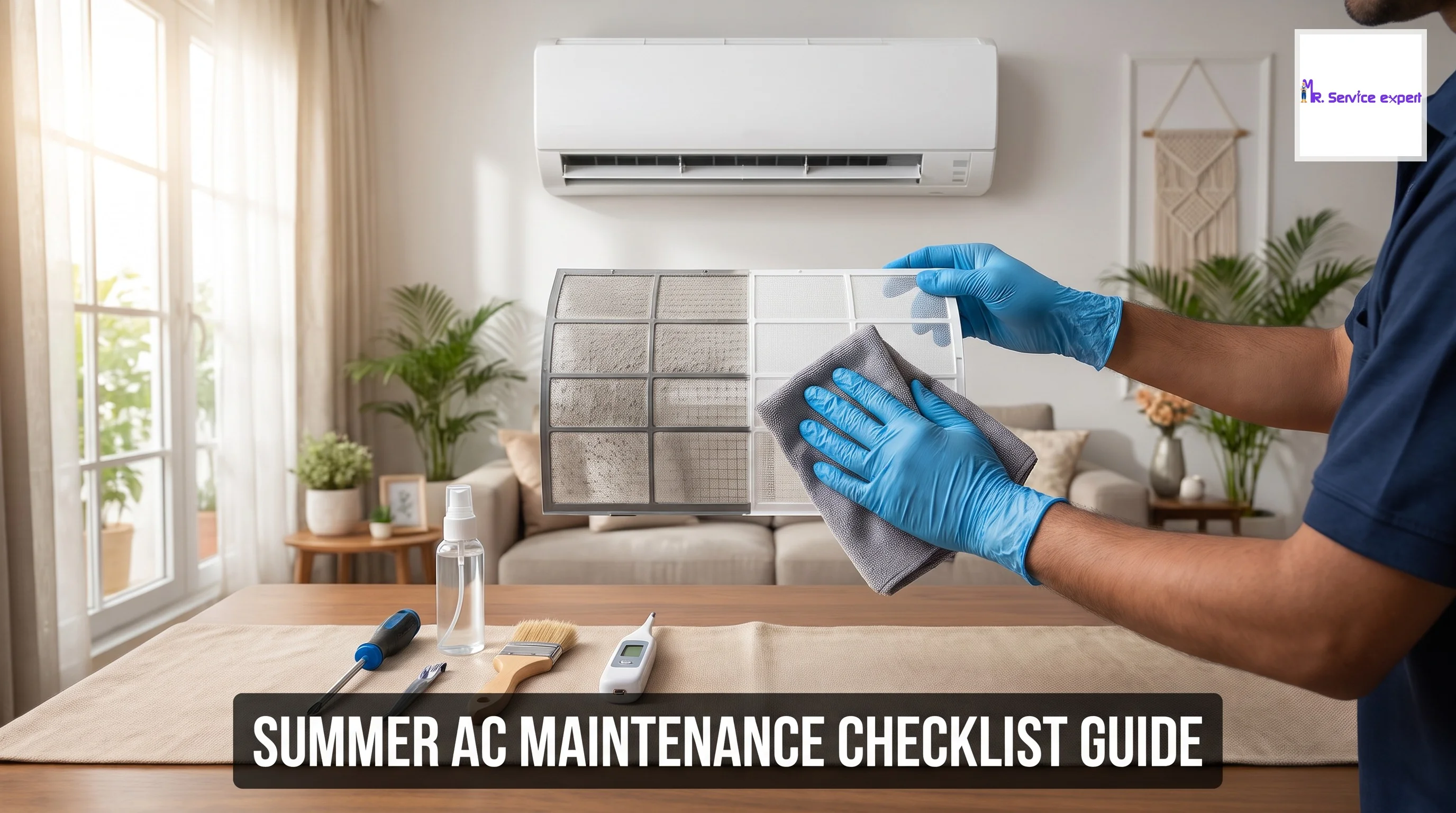
AC Maintenance Checklist for Summer
As temperatures soar across India during the summer months, your air conditioner becomes an essential appliance for maintaining comfort in your home. However, an AC unit that hasn't been properly maintained can struggle to deliver cool air efficiently, consume excessive electricity, and even break down when you need it most. Regular AC maintenance service is not just about keeping your home cool—it's about ensuring your unit runs efficiently, lasts longer, and provides healthy air quality for your family.
Summer places the highest demand on your air conditioning system, making it the worst time for unexpected failures. A well-maintained AC can reduce energy consumption by up to 15 percent, saving you significant money on electricity bills throughout the season. Moreover, neglecting routine maintenance can lead to serious issues like refrigerant leaks, compressor failures, and poor indoor air quality that affects your family's health. Indian summers are particularly harsh, with temperatures exceeding 45 degrees Celsius in many regions, which puts tremendous strain on cooling systems.
This comprehensive AC summer checklist will guide you through essential maintenance tasks that every homeowner should perform or arrange before and during the hot season. Whether you plan to handle some basic maintenance yourself or schedule professional AC service, understanding what needs to be done will help you make informed decisions. From filter cleaning to refrigerant level checks, each step plays a crucial role in keeping your cooling system in optimal condition.
The good news is that most AC maintenance tasks are straightforward and can prevent costly AC repair bills down the line. By following a systematic approach to AC servicing tips, you can extend your unit's lifespan by several years while ensuring consistent cooling performance. Some tasks you can handle yourself, while others require the expertise of a qualified AC technician who has the proper tools and knowledge to service your system safely and effectively.
This article provides a complete maintenance roadmap designed specifically for Indian climate conditions and common AC types used in homes across the country. Whether you own a window AC, split AC, or inverter AC, these guidelines will help you prepare your cooling system for the demanding summer season ahead, ensuring comfort, efficiency, and reliability when outdoor temperatures peak.
Understanding the Importance of Pre-Summer AC Maintenance
Before the summer heat becomes unbearable, conducting thorough AC maintenance can make the difference between a cool, comfortable home and a malfunctioning system during a heatwave. Many homeowners make the mistake of waiting until their AC stops working before calling for AC service, which often results in longer wait times, higher repair costs, and uncomfortable living conditions. Preventive maintenance is always more cost-effective than emergency repairs, particularly during peak summer months when AC technician availability becomes limited and service charges increase.
The pre-summer period—typically late February through April in most parts of India—represents the ideal window for comprehensive AC servicing. During this time, service providers are less busy, making it easier to schedule appointments and often securing better rates. Additionally, any issues discovered during maintenance can be addressed before you actually need to run your AC continuously, preventing mid-summer breakdowns that leave you sweltering in the heat.
Regular maintenance directly impacts your electricity bills, which can skyrocket during summer months. A dirty air filter alone can increase energy consumption by 5 to 15 percent, while refrigerant leaks, clogged coils, and motor issues compound this inefficiency. Indian households already face high power costs, and an inefficient AC can account for up to 60 percent of your summer electricity expenses. Proper AC maintenance ensures your system operates at peak efficiency, cooling your space using minimal power.
Beyond financial considerations, maintenance affects your health and wellbeing. Air conditioners that haven't been serviced accumulate dust, pollen, mold, and bacteria in their filters and ducts, circulating these contaminants throughout your home every time the system runs. This can trigger allergies, respiratory problems, and other health issues, particularly in children and elderly family members. A clean, well-maintained AC provides better indoor air quality, creating a healthier living environment for everyone.
Essential Filter Cleaning and Replacement
Air filters represent the first line of defense in your AC system, capturing dust, dirt, pollen, and other airborne particles before they enter your home or clog internal components. Over time, these filters accumulate debris that restricts airflow, forcing your AC to work harder to circulate air and maintain desired temperatures. This is why filter maintenance tops every AC summer checklist—it's simple, inexpensive, and delivers immediate benefits in terms of efficiency and air quality.
For most Indian households, filters should be inspected monthly during summer and cleaned or replaced as needed. If you live in a particularly dusty area, near construction sites, or in cities with high pollution levels like Delhi or Mumbai, you may need to clean filters every two weeks. The process is straightforward: turn off the AC, remove the filter panel, gently vacuum or wash the filter with mild soap and water, allow it to dry completely, and reinstall it. Never run your AC without filters, as this allows dirt to enter internal components, causing potential damage.
Different AC types have different filter configurations. Split ACs typically have washable filters that can be reused multiple times, while some advanced models feature electrostatic or HEPA filters that may require periodic replacement. Window ACs generally have easily accessible foam or mesh filters that can be cleaned weekly during heavy use periods. Always consult your user manual to identify your filter type and follow manufacturer recommendations for cleaning frequency and replacement intervals.
Consider upgrading to high-efficiency filters if your current filters seem ineffective or if family members suffer from allergies or respiratory conditions. HEPA filters can capture particles as small as 0.3 microns, including most allergens, bacteria, and even some viruses, though they may slightly reduce airflow and require more frequent replacement. The investment in quality filters pays dividends in improved air quality and reduced strain on your AC system, making this one of the most valuable AC servicing tips for health-conscious homeowners.
Cleaning Condenser and Evaporator Coils
The condenser and evaporator coils form the heart of your AC's cooling mechanism, transferring heat from inside your home to the outside environment. Over months of operation, these coils accumulate layers of dust, grime, and debris that act as insulation, preventing efficient heat transfer and forcing your system to run longer cycles to achieve the same cooling effect. Dirty coils can reduce AC efficiency by 30 percent or more, dramatically increasing energy consumption and accelerating component wear.
The evaporator coil, located inside your indoor unit, requires careful cleaning to maintain optimal performance. This coil operates in a cold, humid environment that makes it particularly susceptible to mold and mildew growth, which not only reduces efficiency but also creates unpleasant odors and health hazards. While some homeowners attempt DIY evaporator coil cleaning using commercially available coil cleaners, this task is best left to professionals during scheduled AC maintenance service visits, as improper cleaning can damage delicate fins and require costly repairs.
The condenser coil, found in your outdoor unit, faces exposure to weather, dust, leaves, and other environmental contaminants. You can perform basic condenser maintenance by removing any visible debris around the unit, gently hosing down the coils from inside out (never use high pressure that could bend fins), and ensuring adequate clearance around the unit for proper airflow. However, thorough condenser coil cleaning requires specialized tools and chemicals that professionals use to remove stubborn buildup without damaging components.
Professional coil cleaning should occur at least once annually before summer begins, though homes in extremely dusty or polluted areas may benefit from bi-annual cleaning. During this service, technicians use appropriate cleaning solutions, fin combs to straighten bent coil fins, and proper techniques to restore coils to near-original condition. This investment typically costs between INR 500 to INR 1500 depending on your AC type and location, but the energy savings and extended equipment life make it worthwhile for most homeowners.
Checking and Maintaining Refrigerant Levels
Refrigerant serves as the lifeblood of your air conditioning system, absorbing heat from indoor air and releasing it outside to create the cooling effect. Unlike fuel in a vehicle, refrigerant doesn't get consumed during operation—it circulates continuously in a closed loop. Therefore, low refrigerant levels almost always indicate a leak somewhere in the system, which requires professional attention from a qualified AC technician who can locate the leak, repair it, and properly recharge the system.
Signs of low refrigerant include inadequate cooling despite the AC running continuously, ice formation on the indoor coil or refrigerant lines, hissing or bubbling sounds near the AC unit, and unusually high electricity bills due to the system working harder to compensate. If you notice any of these symptoms, schedule AC repair immediately rather than continuing to operate the system, as running an AC with low refrigerant can damage the compressor—the most expensive component to replace, often costing INR 8000 to INR 15000 or more.
Refrigerant handling requires specialized equipment, training, and certification due to environmental and safety concerns. Never attempt to check refrigerant levels or recharge your system yourself. Only licensed professionals have the gauges, recovery equipment, and knowledge to safely work with refrigerants like R-22, R-410A, or R-32 commonly used in Indian ACs. Additionally, improper refrigerant charging can reduce efficiency, damage components, and void manufacturer warranties, making professional service essential.
During your pre-summer AC maintenance service, request that the technician check refrigerant levels and inspect for potential leaks. This preventive measure can identify small leaks before they become major problems, saving you money and ensuring consistent cooling performance throughout summer. Modern leak detection methods include electronic leak detectors, ultraviolet dye systems, and pressure testing, all of which help pinpoint even tiny leaks that might otherwise go unnoticed until system failure occurs.
Inspecting and Cleaning Drainage Systems
Your air conditioner removes humidity from indoor air as part of the cooling process, with condensed water collecting in a drain pan and exiting through a drainage pipe. During summer, a typical home AC can remove several liters of water daily, all of which must drain properly to prevent water damage, mold growth, and system malfunctions. A clogged drain line ranks among the most common AC problems during humid summer months, making drainage system inspection an essential part of your AC summer checklist.
The condensate drain line, usually a PVC pipe, can become blocked by algae growth, dirt, insects, or debris, causing water to back up into the drain pan and potentially overflow into your home. Signs of drainage problems include water pooling around your indoor unit, musty odors, water stains on walls or ceilings near the AC, and the AC shutting off automatically due to overflow safety switches. Regular drain line maintenance prevents these issues and ensures proper humidity control.
For basic drain line maintenance, locate the drain pan beneath your indoor unit and check for standing water, which indicates a blockage. You can often clear minor clogs by pouring a cup of white vinegar or a specialized drain line treatment down the drain access point, which helps dissolve algae and biofilm buildup. For stubborn clogs, a wet-dry vacuum can be used to suction out blockages from the outdoor end of the drain line, though care must be taken not to damage the pipe or create leaks.
Professional AC service includes thorough drain line cleaning using specialized tools and treatments that prevent future clogs. Technicians can install drain line traps correctly, ensure proper slope for gravity drainage, treat lines with algaecide tablets that provide months of protection, and verify that condensate pumps (if equipped) function properly. This comprehensive approach typically costs between INR 300 to INR 800 as part of a full service package and prevents water damage that could cost thousands to repair.
Electrical Components and Connection Checks
The electrical system powering your air conditioner includes capacitors, contactors, relays, wiring, and connections that must function flawlessly for safe, reliable operation. Over time, electrical components degrade due to heat, humidity, and the constant on-off cycling that occurs during normal AC operation. Faulty electrical components cause numerous problems ranging from inefficient operation to complete system failure, and in some cases, can even create fire hazards that endanger your home and family.
Capacitors, which provide the electrical boost needed to start the compressor and fan motors, are among the most frequently failing AC components, especially in hot climates. A failing capacitor produces symptoms like the AC struggling to start, making humming noises without starting, running briefly then shutting off, or not starting at all. Capacitor replacement is relatively inexpensive, typically costing INR 400 to INR 1200 including labor, but requires professional service as these components store dangerous electrical charges even when power is disconnected.
Loose electrical connections create resistance that generates heat, wastes energy, and can eventually cause component failure or electrical fires. During professional maintenance, technicians tighten all electrical connections, inspect wiring for signs of damage or overheating, test voltage and amperage to ensure they fall within manufacturer specifications, and verify that circuit breakers and disconnect switches function properly. These checks prevent many common electrical problems that cause mid-summer AC failures.
Homeowners should perform basic electrical safety checks by ensuring the outdoor unit's disconnect switch is functional, verifying that circuit breakers haven't tripped, listening for unusual electrical buzzing or crackling sounds, and watching for lights dimming when the AC starts, which suggests electrical problems. However, all actual electrical work must be performed by qualified professionals, as improper repairs can void warranties, violate electrical codes, and create serious safety hazards. Never attempt to open electrical panels or touch internal components yourself.
Fan Motor and Belt Maintenance
The fan motors in your AC system—one in the indoor unit that circulates air through your home and one in the outdoor unit that expels heat—work tirelessly throughout summer, making their proper maintenance crucial for reliable operation. These motors contain bearings that require lubrication, electrical components that can fail, and mounting hardware that can loosen over time. Regular fan system maintenance prevents breakdowns and ensures optimal airflow for efficient cooling and even temperature distribution.
Indoor blower motors move large volumes of air across the evaporator coil and through your ductwork or directly into your room. If this motor fails or runs inefficiently, you'll notice reduced airflow from vents, unusual noises like squealing or grinding, or the AC running without producing adequate cooling. Some older AC models use belt-driven blower motors that require periodic belt inspection and replacement, while modern systems typically use direct-drive motors that need less maintenance but still require regular inspection.
Outdoor fan motors face harsh conditions including extreme heat, rain, dust, and temperature fluctuations, making them particularly vulnerable to failure during peak summer. These motors should spin freely without wobbling, run quietly without excessive vibration, and maintain consistent speed. During AC maintenance service, technicians lubricate motor bearings (on models with ports for lubrication), check motor windings for proper resistance, verify that fan blades are balanced and undamaged, and ensure adequate electrical current flow.
Dirt accumulation on fan blades reduces efficiency and creates imbalance that can damage motors and bearings. Cleaning fan blades during regular maintenance prevents this problem, though outdoor fans should be cleaned more frequently in dusty environments. Additionally, ensuring that outdoor units have proper clearance—at least two feet on all sides—allows adequate airflow and prevents the motor from overheating. These simple AC servicing tips can extend motor life by years and prevent expensive emergency repairs during the hottest days of summer.
Thermostat Calibration and Settings Optimization
Your thermostat controls when and how your AC operates, making it the brain of your cooling system. An improperly calibrated or malfunctioning thermostat can cause your AC to run excessively, cycle too frequently, fail to maintain desired temperatures, or not operate at all. Regular thermostat maintenance ensures accurate temperature control, optimal comfort, and efficient energy use throughout the summer season.
Learn more about maximizing your AC's efficiency this summer with a comprehensive maintenance approach. Regular servicing helps your cooling system operate at peak performance, reduces energy consumption by up to 15%, and extends equipment lifespan. Explore further how preventive care—including filter cleaning, refrigerant checks, and coil maintenance—can save you from costly mid-summer breakdowns while keeping your home consistently comfortable throughout the hottest months.